As 2016 comes to a close, we look back at the most viewed blog posts of 2016. #7 is Using a GDD Tracker for Applications.
Exceptional spring warm is present across the Midwest. Due to this,
spring applications are weeks ahead of schedule. A grounds manager can
track growing degree days (GDD), but the easiest way to follow the GDD progress is to use the Growing Degree Day Tracker brought to you by the Midwest Regional Turf Foundation and Purdue Turfgrass.
This tool is a great way to assist you decision making on crabgrass control
applications and many other applications of time sensitive products.
Go to j-dturf.com to learn more about J&D Turf.
Play on!
--Jamie
@JamieMehringer
Wednesday, December 21, 2016
Wednesday, December 14, 2016
Most Viewed Blog Posts of 2106 - #8 - How to Add New Mix and Level Baselines
As 2016 comes to a close, we look back at the most viewed blog posts in 2016. #8 - How to Add New Mix and Level Baselines
Step 2 Till the new material into the existing material. Ideally, the tilling depth is 3-4 inches. In this example, Dura Edge Pro was added/tilled to existing Dura Edge Pro baselines.
Step 3 Re-screed the tilled material.
Step 4 Using a 3 ton dual drum roller, roll the baselines.
This entire project for both baselines took approximately 3 hours.
Download the Smart Turf Sheet - How to: Add New Mix and Level Baselines
Maintaining baselines
that create a smooth and safe surface can be challenging. The photos below
outline the process of adding new material to baselines. This leveling process
will work on any baseball surface. Keep in mind, if leveling with a board,
address all “lips” before grading.
Step 1 Edge the sod to
create clean edges (address any “lips” as well). Then, add infield mix to the
baselines and, using a 2x4 screed board, level the next material.
Step 2 Till the new material into the existing material. Ideally, the tilling depth is 3-4 inches. In this example, Dura Edge Pro was added/tilled to existing Dura Edge Pro baselines.
Step 3 Re-screed the tilled material.
Step 4 Using a 3 ton dual drum roller, roll the baselines.
Step 5 Add conditioner
and drag.
This entire project for both baselines took approximately 3 hours.
Now the baselines are
level and create smooth transitions between the turf and the infield mix.
Play on!
--Jamie
Download the Smart Turf Sheet - How to: Add New Mix and Level Baselines
The original post can be viewed here.
Sunday, December 11, 2016
Most Viewed Blog Posts in 2016 - #9 - A Tale of Two Walk Ups
As 2016 comes to a close, we are looking back at the 10 most viewed blog posts in 2016. Here is #9....
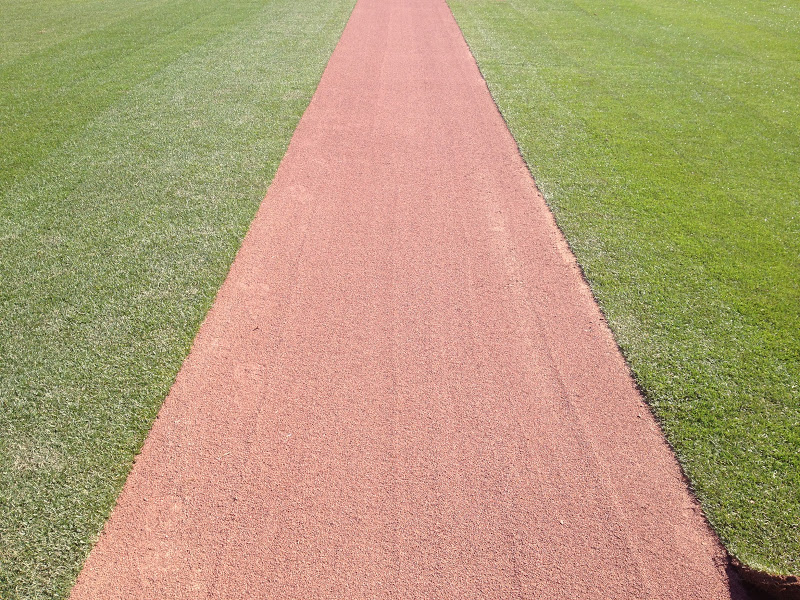
Walk-ups for baseball and softball fields are often a good option to manage traffic while also allowing for grass in foul territory (softball). This is sometimes necessary to manage surface drainage/grades.
Let’s look at two walk-ups. First, the softball field at Ohio Northern University. As you can see these walk-ups are the same width from the warning track to the plate, so the on-deck circle is off the walk-up.
The next example is at the MLB/P&G Cincinnati Reds Urban Youth Academy. In this example, the walk-ups are flared out as you get closer to the track. This allows for the on-deck circles to be on the walk-ups.
Also, you can see this early season photo also illustrates how walk-ups can aid in surface drainage.
Which is the best option? That’s a field manager’s decision. I personally like the flared walk-up which allows for space for the on-deck circle.
Go to j-dturf.com to learn more about J&D Turf.
Play on!
--Jamie
@JamieMehringer
Walk-ups for baseball and softball fields are often a good option to manage traffic while also allowing for grass in foul territory (softball). This is sometimes necessary to manage surface drainage/grades.
Let’s look at two walk-ups. First, the softball field at Ohio Northern University. As you can see these walk-ups are the same width from the warning track to the plate, so the on-deck circle is off the walk-up.
The next example is at the MLB/P&G Cincinnati Reds Urban Youth Academy. In this example, the walk-ups are flared out as you get closer to the track. This allows for the on-deck circles to be on the walk-ups.
Also, you can see this early season photo also illustrates how walk-ups can aid in surface drainage.
Which is the best option? That’s a field manager’s decision. I personally like the flared walk-up which allows for space for the on-deck circle.
Go to j-dturf.com to learn more about J&D Turf.
Play on!
--Jamie
@JamieMehringer
Tuesday, December 6, 2016
Most Viewed Blog Posts in 2016 - #10 - Infield Mix Mix Drainage for Baseball and Softball
As 2016 quickly arrives to a close, we take our yearly look back at the Top 10 most viewed blog posts in 2016. Below is #10 - Infield Mix Mix Drainage for Baseball and Softball
Infield drainage is typically a topic for discussion anytime I give a presentation on infield mixes, grades, etc. So, when the J&D Turf team was tasked to remedy an infield drainage issue at University of Indianapolis, the team chronicled their work with photos.
Before we get to the photos, lets lay out a couple of items in regards to infield drainage:
1.
Do NOT install drain tiles under the infield mix. The
infield mix should be engineered and maintained to eliminate downward movement
(percolation) of water. All water during rain events should run off the
infield.
2.
Due to item #1, positive surface drainage must be achieved on ALL
infields. For baseball and softball, surface drainage should be between
.5% and 1%. Keep in mind, if a softball field does not have sod in front
of dugouts, surface drainage should be NO MORE than .5%. Does your
infield conditioner run off your infield? Chances are, the infield has
surface drainage exceeding the limits listed above.
3.
Purchase and manage a good infield mix. Be careful when purchasing
infield mix! To learn more about infield mixes, click HERE and HERE.
So, lets explain what the
existing conditioners were at Baumgartner Field at University of Indianapolis:
1.
Native soil.
2.
Due to existing topography, the grade falls from the RF foul pole
to the 3rd base dugout.
3.
Bluegrass/Ryegrass surface
4.
Infield Mix - Dura Edge Classic
5.
Conditioner - Diamond Pro Professional Calcined Clay
6.
Mound Clay - Dura Pitch Mound Clay
7.
During rain events, water would run from RF under the tarp and
become trapped.
The solution:
Install a six-inch wide
trench:
Then, installation of 6 inches of USGA rootzone sand all the way to the surface. Then the existing sod was re-installed. DO NOT seal off drain tiles by placing native soil over drainage gravel.
Finally, an edger was used to run across the trench/slit and expose 3 inches of the sand. The bluegrass will grow into the sand.
The location of the drain tile while the tarp is on the field.
Lastly, the field ready for play the day after installation.
Mission accomplished!
Best of luck to the Lady Greyhounds as they begin the road to the D-II College World Series.
Click HERE to learn more about Dura Edge Classic and Dura Pitch Mound Clay.
Click HERE to learn more about Diamond Pro Professional Calcined Clay.
Click HERE to learn more about UIndy softball
Go to j-dturf.com to learn more about J&D Turf.
Play on!
--Jamie
@JamieMehringer
Wednesday, November 23, 2016
How Do You Repair a Batters Box?
I get this question numerous times in my travels. So, let's look into the repair:
First, the plate after the game:
First step, rake the plate with a landscape rake. Look to lower high areas:
First, the plate after the game:
First step, rake the plate with a landscape rake. Look to lower high areas:
Second
step, remove all conditioner and loose clay by using the leveling blade
on the rake and a broom: NOTICE - the use of both a push broom and a
standard broom and how clean to sweep the batters box. NO loose
material should be present.
Third
step, add water to hydrate the existing clay. This can be accomplished
with a garden hose, watering can, or a sprayer/spray bottle:
Next step, add new mound clay. In this case Dura Pitch Mound Clay was added:
Then, rake new clay into place and use a flat bladed shovel to chop the new clay into the existing clay:
After adding the clay, lightly compact the clay with your foot and then tamp using a hand tamp:
Then, rake the compacted clay in 3 directions to level the clay.
Next
step, use a small amount of water to hydrate the clay and use your foot
to smear the clay together and blend all the seams into one solid piece
of clay:
Then,
push the existing conditioner to the plate, screen with leaf rake and
add conditioner as needed to maintain a 1/4 inch depth of conditioner:
Lastly, finish drag,water and paint the plate.
Use this program, and your plate area will be the best in your league.
Go to j-dturf.com to learn more about J&D Turf.
Play on!
--Jamie
@JamieMehringer
Wednesday, November 9, 2016
Can I Renovate My Brickdust Infield? - YES!
I get this question all the time, the short answer is YES.
Now, for more detail. I have included two photos below of two different fields in Noblesville, IN. The first photo shows an infield that was renovated by J&D Turf at Noblesville HS. The field was 4 inches of brickdust. We added on truckload of FieldSaver 50 from the Natural Sand Company, blecavated the FS 50 into the brickdust, rolled and laser graded the infield. Finally the field was conditioned with two tons of Diamond Pro Professional Calcined Clay and one ton of Diamond Pro Red Infield Conditioner. The picture is from last week. The field is playing great. I call it a "hybrid infield". Not what I would do in the consulting/construction phase, but it gets the customer to a more typical infield surface for a third of the cost. The photo below the renovated field is a straight brickdust surface that has not been renovated. We have performed this process to in excess of 20 fields, and the all are doing really well.
Why are coaches wanting to eliminate their brickdust? A few reasons:
1.When added to a field in excess of 1/2 inch brickdust becomes VERY loose when dry
2.Brickdust breaks down into a powder, calcined clays and vitrified clays will not
3.Brickdust stains uniforms
4.In Indiana, brickdust costs in excess of $100 a ton delivered. The FS 50 amendment alone was less than $100 a ton and it fixed the field!
Some facilities wanted to maintain a dark red topdressing. For those customers, we used a straight 1/4 inch of Diamond Pro Red Infield Conditioner.
The cost for a “hybrid infield” - approx $8,000-$10,000
The cost for removing the brickdust and replacing it with 4 inches of a good balanced infield mix - approx $25,000-$30,000
To learn more about renovating infields and adding new material into existing material click HERE and HERE
To learn more about Natural Sand, click HERE
To learn more about Diamond Pro, click HERE
Go to j-dturf.com to learn more about J&D Turf.
Play on!
--Jamie
Now, for more detail. I have included two photos below of two different fields in Noblesville, IN. The first photo shows an infield that was renovated by J&D Turf at Noblesville HS. The field was 4 inches of brickdust. We added on truckload of FieldSaver 50 from the Natural Sand Company, blecavated the FS 50 into the brickdust, rolled and laser graded the infield. Finally the field was conditioned with two tons of Diamond Pro Professional Calcined Clay and one ton of Diamond Pro Red Infield Conditioner. The picture is from last week. The field is playing great. I call it a "hybrid infield". Not what I would do in the consulting/construction phase, but it gets the customer to a more typical infield surface for a third of the cost. The photo below the renovated field is a straight brickdust surface that has not been renovated. We have performed this process to in excess of 20 fields, and the all are doing really well.
Why are coaches wanting to eliminate their brickdust? A few reasons:
1.When added to a field in excess of 1/2 inch brickdust becomes VERY loose when dry
2.Brickdust breaks down into a powder, calcined clays and vitrified clays will not
3.Brickdust stains uniforms
4.In Indiana, brickdust costs in excess of $100 a ton delivered. The FS 50 amendment alone was less than $100 a ton and it fixed the field!
Some facilities wanted to maintain a dark red topdressing. For those customers, we used a straight 1/4 inch of Diamond Pro Red Infield Conditioner.
The cost for a “hybrid infield” - approx $8,000-$10,000
The cost for removing the brickdust and replacing it with 4 inches of a good balanced infield mix - approx $25,000-$30,000
To learn more about renovating infields and adding new material into existing material click HERE and HERE
To learn more about Natural Sand, click HERE
To learn more about Diamond Pro, click HERE
Go to j-dturf.com to learn more about J&D Turf.
Play on!
--Jamie
Thursday, November 3, 2016
Late Fall Fertilizer Applications
With cooler weather approaching the area, it is time to discuss late
season fertilizer applications. Why is it beneficial? When should it
be applied? Click HERE
to see a Turf Tip from Dr. Aaron Patton from Purdue University. Will
you be applying late fall fertilizer to your athletic fields?
Go to j-dturf.com to learn more about J&D Turf.
Play on!
--Jamie
@JamieMehringer
Go to j-dturf.com to learn more about J&D Turf.
Play on!
--Jamie
@JamieMehringer
Subscribe to:
Posts (Atom)


