Many areas around the country are beginning to experience cool/cold
night temperatures this week. This is a reminder to stay off frost covered
turf. Below is what many turf areas looked like across the upper Midwest
early this morning.
For additional information in regards to frost covered turf, click HERE for a publication in regards to turf and frost from the USGA. Click HERE for a publication from Ohio State University
Go to j-dturf.com to learn more about J&D Turf.
Play on!
--Jamie
@JamieMehringer
Monday, October 24, 2016
Wednesday, October 12, 2016
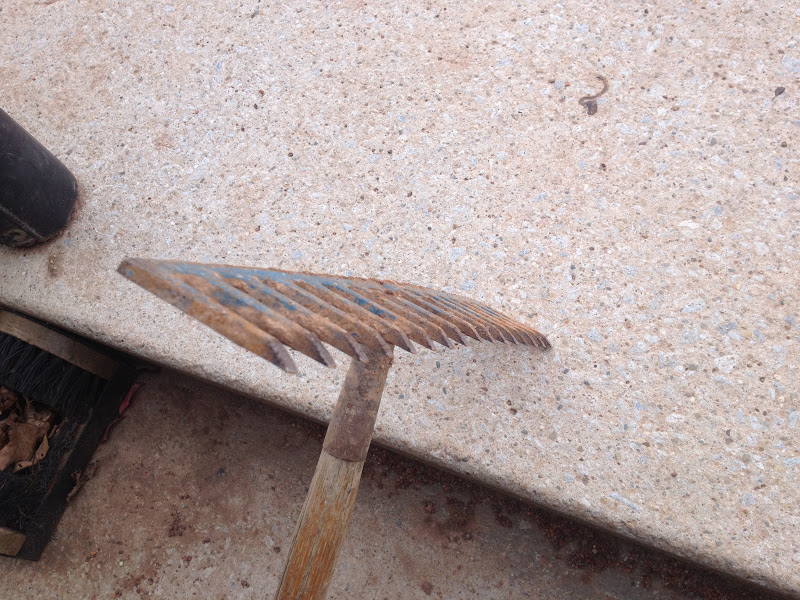
Tricks of the Trade - Sharpening a Rake
Fall mound and plate renovations are in full swing. A quick tip to turn a standard steel garden rake into a clay shaving tool.
Take a standard tine rake to a bench grinder and sharpen the teeth. Now, the rake is a clay shaving tool:
Go to j-dturf.com to learn more about J&D Turf
Play on!
--Jamie
@JamieMehringer
Take a standard tine rake to a bench grinder and sharpen the teeth. Now, the rake is a clay shaving tool:
Go to j-dturf.com to learn more about J&D Turf
Play on!
--Jamie
@JamieMehringer
Tuesday, September 27, 2016
Grass Baselines for a Baseball Field?
Many schools consider grass baselines for baseball fields. I was
visiting this field this past week where I observed this baseline:
As you can see, the baseline is only 1 1/2 ft wide. This width makes the baseline very difficult to maintain with a volunteer grounds crew. Most baselines at the high school level are between 5-6 ft in width. Considering grass baselines? They can be very effective, but they do require in season maintenance.
Go to j-dturf.com to learn more about J&D Turf
Play on!
--Jamie
As you can see, the baseline is only 1 1/2 ft wide. This width makes the baseline very difficult to maintain with a volunteer grounds crew. Most baselines at the high school level are between 5-6 ft in width. Considering grass baselines? They can be very effective, but they do require in season maintenance.
Go to j-dturf.com to learn more about J&D Turf
Play on!
--Jamie
Monday, September 12, 2016
Do Not Layer Infield Mixes!
This week I was at a high school that was have issues with their
infield. I asked the AD if he new what type of material he was using.
He said he didn't but he paid a contractor to add infield mix to his
field a year or two ago, so we dug a hole to take a look. Here is what
we found:
Needless to say the layering is causing an issue as well as using an infield mix that is high in silt and fine sand. Click HERE to see an earlier post on layering infield mixes.
Click HERE to see how to add infield mix to an existing infield.
Go to j-dturf.com to learn more about J&D Turf.
Play on!
--Jamie
@JamieMehringer
Needless to say the layering is causing an issue as well as using an infield mix that is high in silt and fine sand. Click HERE to see an earlier post on layering infield mixes.
Click HERE to see how to add infield mix to an existing infield.
Go to j-dturf.com to learn more about J&D Turf.
Play on!
--Jamie
@JamieMehringer
Thursday, August 25, 2016
Overseeding Cool Season Athletic Fields
The overseeding window for cool season sports turf is open for many
across the Midwest. Lack of overseeding athletic fields and overseeding
at the incorrect rates can be major reasons why athletic fields fail. HERE is a great article from Pat Sherratt at Ohio State University. HERE is a link from an earlier post on the SmartTurf Blog regarding overseeding.
Go to j-dturf.com to learn more about J&D Turf.
Play on!
--Jamie
@JamieMehringer
Go to j-dturf.com to learn more about J&D Turf.
Play on!
--Jamie
@JamieMehringer
Friday, August 19, 2016
Bulk Storage - Dirt Bunkers
A quick post in regards to bulk storage. (aka - dirt bunkers) Bulk
storage is critical to every site due to many cost savings achieved by
purchasing in bulk. Here is a photo of a basic bunker system:
Designs come in all shapes and sizes. Some systems include a roof if infield mix is an intended product to store. Bottom line is, a bunker system, should include at a minimum:
- Hard surface floors - eliminate waste
- Height and width to support a full truckload of material
- Close to the fields for ease of moving material
Are dirt bunkers on your fall "to do list?"
Go to j-dturf.com to learn more about J&D Turf.
Play on!
--Jamie
@JamieMehringer
Tuesday, August 9, 2016
Use Caution with Glyphosate Applications
Many baseball and softball facilities take a back seat in late summer as fall sports take priority at the high school and
recreational levels. Many times, the ground staff will apply glyphosate
to kill/control unwanted weeds and grasses on infields and warning
tracks. Bottom line, if the decision is made to apply these products be
VERY CAREFUL with the application. Here are what infield edges looked
like at a high school I visited this week:
Needless to say, these edges have been severely damaged. Sod will need to be installed to re-set the edges. To avoid this, consider a couple options:
1. Drag infields and warning tracks 2-3 times per week and edge fields at least once a month
2. Apply Sureguard after play to limit weed population. Click HERE to learn more about this process
Go to j-dturf.com to learn more about J&D Turf.
Play on!
--Jamie
@JamieMehringer
Needless to say, these edges have been severely damaged. Sod will need to be installed to re-set the edges. To avoid this, consider a couple options:
1. Drag infields and warning tracks 2-3 times per week and edge fields at least once a month
2. Apply Sureguard after play to limit weed population. Click HERE to learn more about this process
Go to j-dturf.com to learn more about J&D Turf.
Play on!
--Jamie
@JamieMehringer
Subscribe to:
Posts (Atom)